
Most letting software treats tenancy agreements as a document problem.
Generate a PDF. Collect signatures. File it away. Move on.
But tenancy agreements aren't just documents. They create legal relationships that can last years. They get questioned months or years after signing—when a tenant disputes a clause, when a landlord challenges a deposit deduction, when someone claims they didn't understand what they signed.
In reality, tenancy agreements are a process problem. They involve compliance, identity, intent, timing, and evidence. The signature is just one moment in a longer sequence that needs to be handled correctly.
LetAdmin was designed around this entire lifecycle, not just the signature collection. This guide explains our approach—what we built, why we built it that way, and what it means for letting agents who need their agreements to stand up to scrutiny.
The Problem With "Standard" Tenancy Agreement Signing
If you've worked in lettings for any length of time, you know the pain of tenancy agreement signing.
The email chase. You send the agreement as a PDF attachment. Then you wait. And chase. And wait some more. When you have multiple tenants on a joint tenancy, you're chasing each one individually. "Did you sign it yet? Can you send it back? Did you get my email?"
The version confusion. Agreements come back with different dates, different signatures, scanned at different qualities. Which version is the final one? Did everyone sign the same document? Did someone sign an old draft by mistake?
The compliance gaps. Were the prescribed documents included? Was the EPC current when the agreement was sent? Was the Gas Safety certificate valid? If you're assembling document packs manually, these things slip through. Not often, but often enough.
The audit uncertainty. Months later, when a question arises, can you prove what happened? Can you show when the agreement was sent, when each person signed, what documents they received? Or is it all buried in email threads you'd have to reconstruct?
These aren't hypothetical problems. They're Tuesday afternoon at a letting agency.
Why Tenancy Agreements Are Different From Other Documents
Tenancy agreements deserve more care than typical documents because of what they represent.
They create long-running legal relationships. Unlike a one-time contract for services, a tenancy agreement governs an ongoing relationship. The tenant will live in that property for months or years. Issues can arise at any point—and when they do, the agreement becomes the reference point.
They get questioned after the fact. Deposit disputes at the end of tenancy. Rent increase challenges. Claims about what was agreed regarding pets, alterations, or notice periods. These conversations happen months or years after signing, when memories have faded but the agreement remains.
Compliance timing matters as much as signatures. It's not enough that an EPC exists somewhere. The EPC needed to be valid when the tenant signed. The prescribed information needed to be provided before the tenancy started. Compliance is time-sensitive in ways that affect your legal position.
A signature alone is not proof of process. Anyone can claim a PDF signature was added without their knowledge, or that they signed a different version, or that required documents weren't provided. What you need is evidence of the complete process—who did what, when, and in what order.
This is why treating tenancy agreements as "just another document to sign" creates risk that surfaces later.
Designing the Entire Agreement Lifecycle
LetAdmin approaches tenancy agreements as a workflow, not a document generation task.
Agreements are created only when applications are ready. You can't send an agreement before the application is complete—before applicant details are finalised, before the property is confirmed, before the tenancy terms are set. The system enforces the logical sequence.
Compliance is validated before anything is sent. Before an agent can send an agreement for signing, LetAdmin checks:
- Is the EPC certificate current and available?
- Is the Gas Safety certificate valid?
- Is the EICR (electrical safety) certificate current?
- Are all required prescribed information documents prepared?
If something's missing or expired, the agent can't proceed until it's resolved. This isn't bureaucratic obstruction—it's protection. Agreements sent without valid compliance documents create legal exposure that surfaces during deposit disputes or possession proceedings.
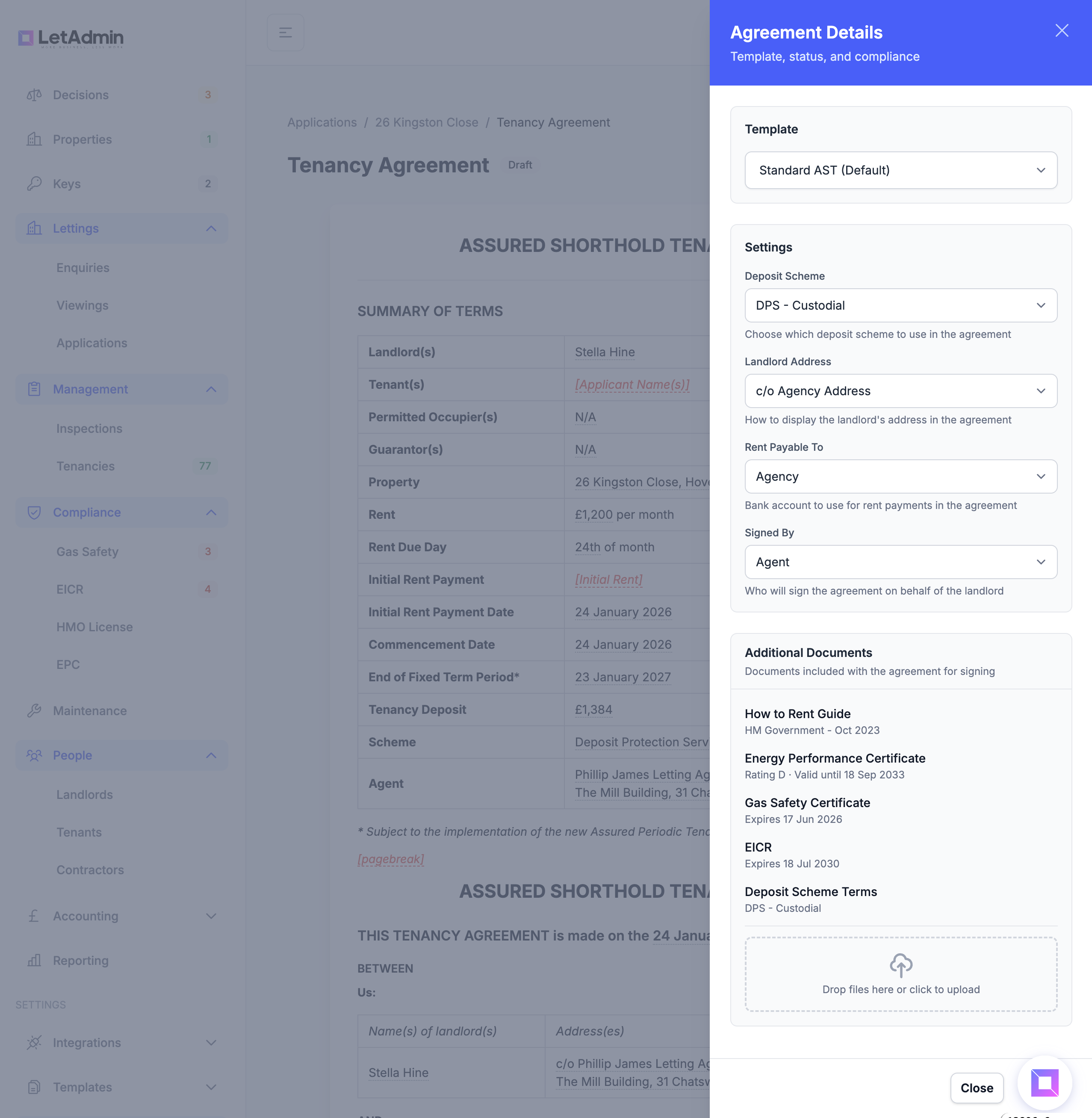
All required documents are included from the outset. When tenants access their agreement for signing, they receive everything as a package: the agreement itself, the EPC, the How to Rent guide, any property-specific documents. There's no "we'll send that separately" that gets forgotten.
One canonical agreement package. There's a single source of truth for each tenancy agreement. Not email attachments scattered across inboxes. Not multiple PDF versions with different dates. One agreement, one status, one history.
Why we didn't bolt tenancy agreement signing onto a third-party tool
Many agencies use external e-signing tools that require documents to be manually assembled, uploaded, and prepared before sending. The agreement PDF is created in one system, compliance documents are gathered elsewhere, and signature fields are placed manually in a third-party interface.
That approach works—until something changes. A document is updated. A certificate expires. A tenant signs the wrong version. Suddenly the "signed agreement" is no longer a reliable record of what actually happened.
LetAdmin avoids this entirely by treating signing as part of the tenancy workflow itself. Documents are generated, bundled, and signed inside a single system, with signatures placed consistently and automatically. There's no duplication of state across tools, and no manual preparation step where errors creep in.
Identity, Intent, and Signing—Proportionately Done
E-signing needs to verify that the right person signed with genuine intent. But verification shouldn't be so onerous that tenants abandon the process.
For a detailed explanation of how LetAdmin meets UK legal requirements for electronic signatures, including Advanced Electronic Signature (AES) compliance, see our Security and Legal Compliance Guide.
Portal-based access. Tenants receive a secure link to their agreement portal. This isn't a public URL anyone could stumble upon—it's tied to their specific application and accessible only through a link sent to their verified email address.
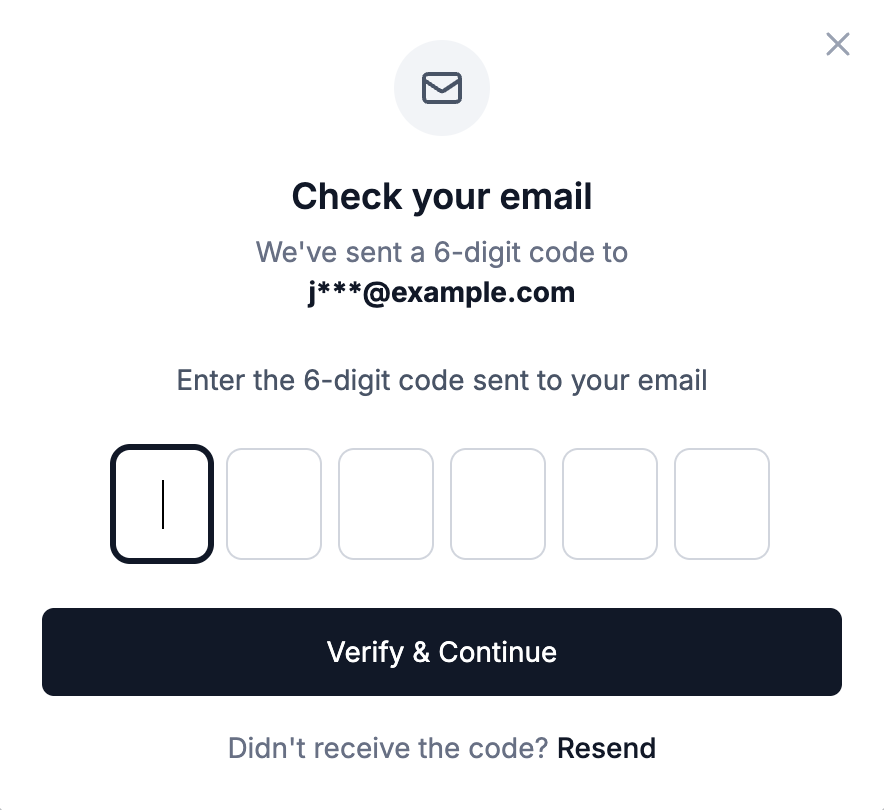
One-time verification codes. Before signing, tenants verify their identity through a code sent to their email. This creates an auditable record: the person who signed is the person who controls that email address. It's the same email address the agent has been communicating with throughout the application.
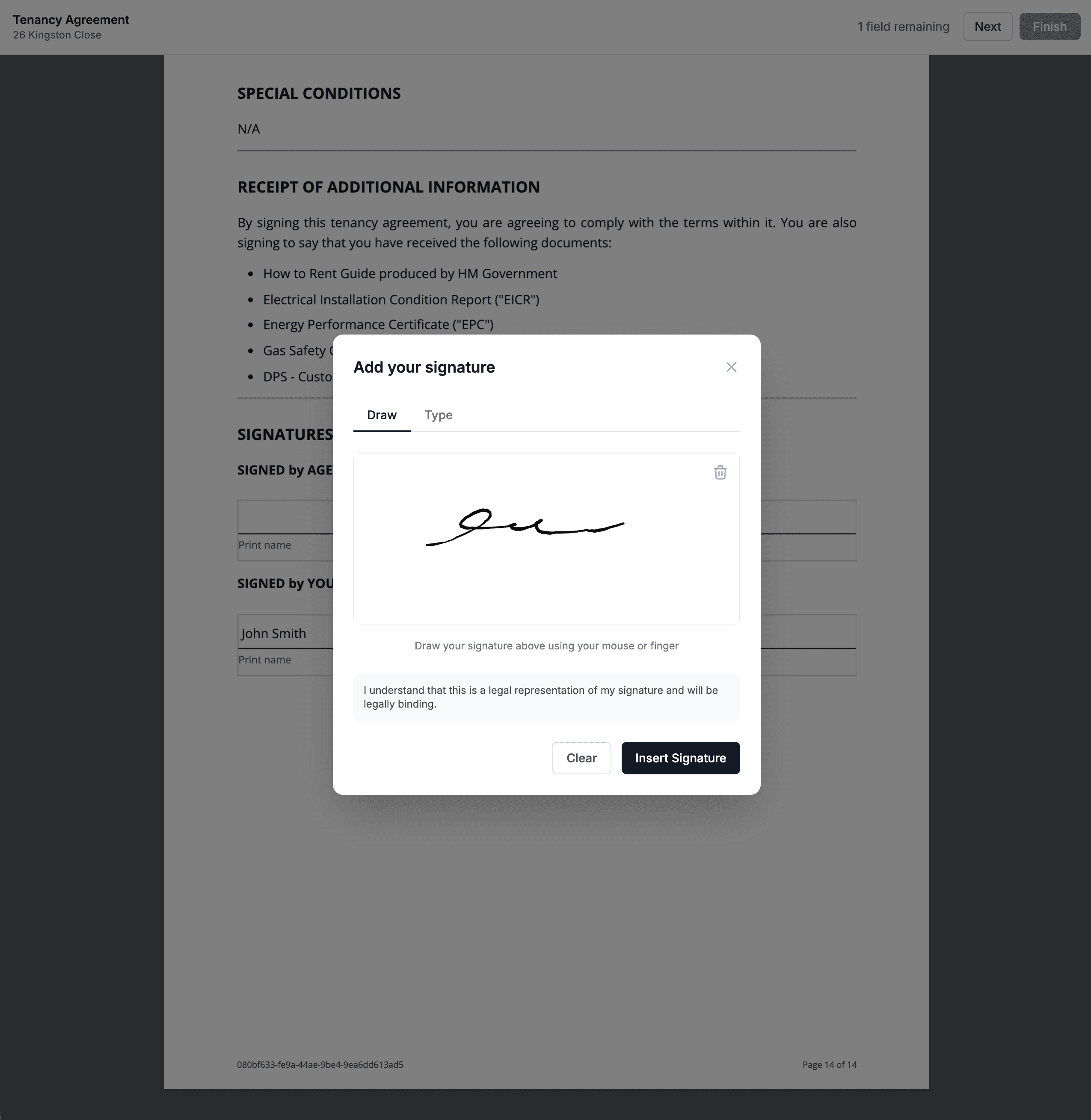
Explicit intent confirmation. Signing isn't a single click. Tenants review the agreement in a proper PDF viewer—the actual document they're agreeing to. They apply their signature (drawn on touchscreen or typed). Then they explicitly confirm: "I confirm I have read and agree to this tenancy agreement." This deliberate sequence demonstrates intent.
The approach is proportionate: strong enough to stand up to scrutiny if challenged, simple enough that tenants don't complain about the process. We're not asking for notarised documents or in-person verification—just reasonable confirmation that the person signing is who they claim to be and understands what they're signing.
Multi-Party Signing Without Chaos
Joint tenancies create complexity. Multiple people need to sign the same agreement, often at different times, from different locations.
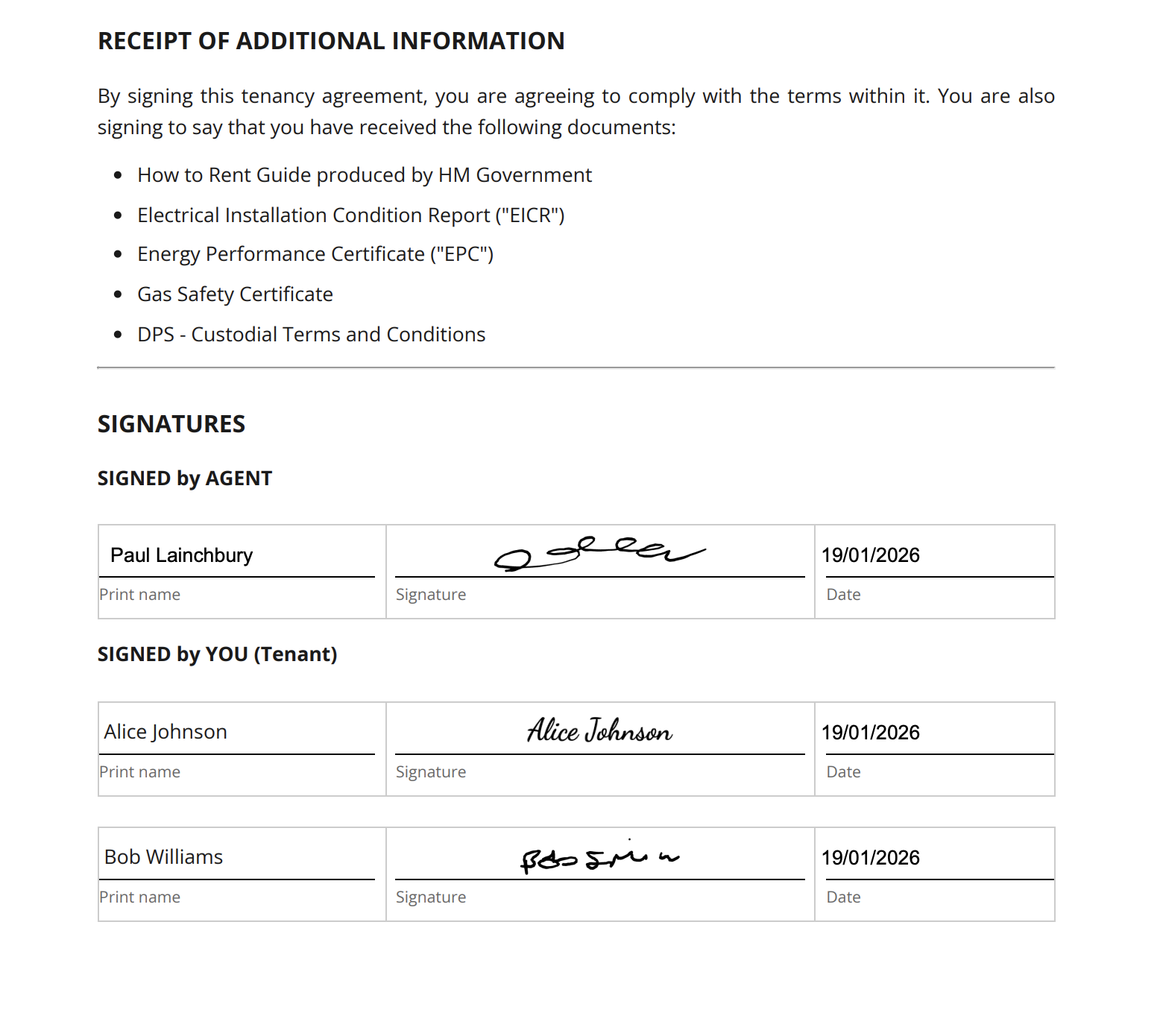
Each tenant signs independently. Every tenant on the agreement gets their own signing link and completes their own verification. There's no "one person signs for everyone" or passing a tablet around. Each signature is individually authenticated.
Partial signing visibility. Agents can see exactly who has signed and who hasn't. If three tenants need to sign and two have completed, you can see that at a glance—without checking email threads or calling people to ask.
Automated reminders. Tenants who haven't signed receive daily reminders (sent at sensible hours). The system does the chasing. Your team doesn't need to track who's outstanding and manually follow up.
No manual agent intervention required. The entire multi-party signing flow happens automatically. Agents don't need to monitor progress, send reminder emails, or coordinate timing. They're notified when everyone has signed and the agreement is ready for countersigning.
This matters for agencies managing dozens of tenancies simultaneously. When signing progress is visible and chasing is automated, nothing gets lost and nobody wastes time on follow-up that software should handle.
Countersigning and Finalisation
Many systems stop caring about correctness after tenant signatures are collected. LetAdmin continues through to completion.
Agent countersigning after all tenants. Once every tenant has signed, the agent receives a notification in their decision queue. They review the completed signatures—confirming that all parties have signed the same document—and countersign on behalf of the agency. Only then is the agreement legally complete.
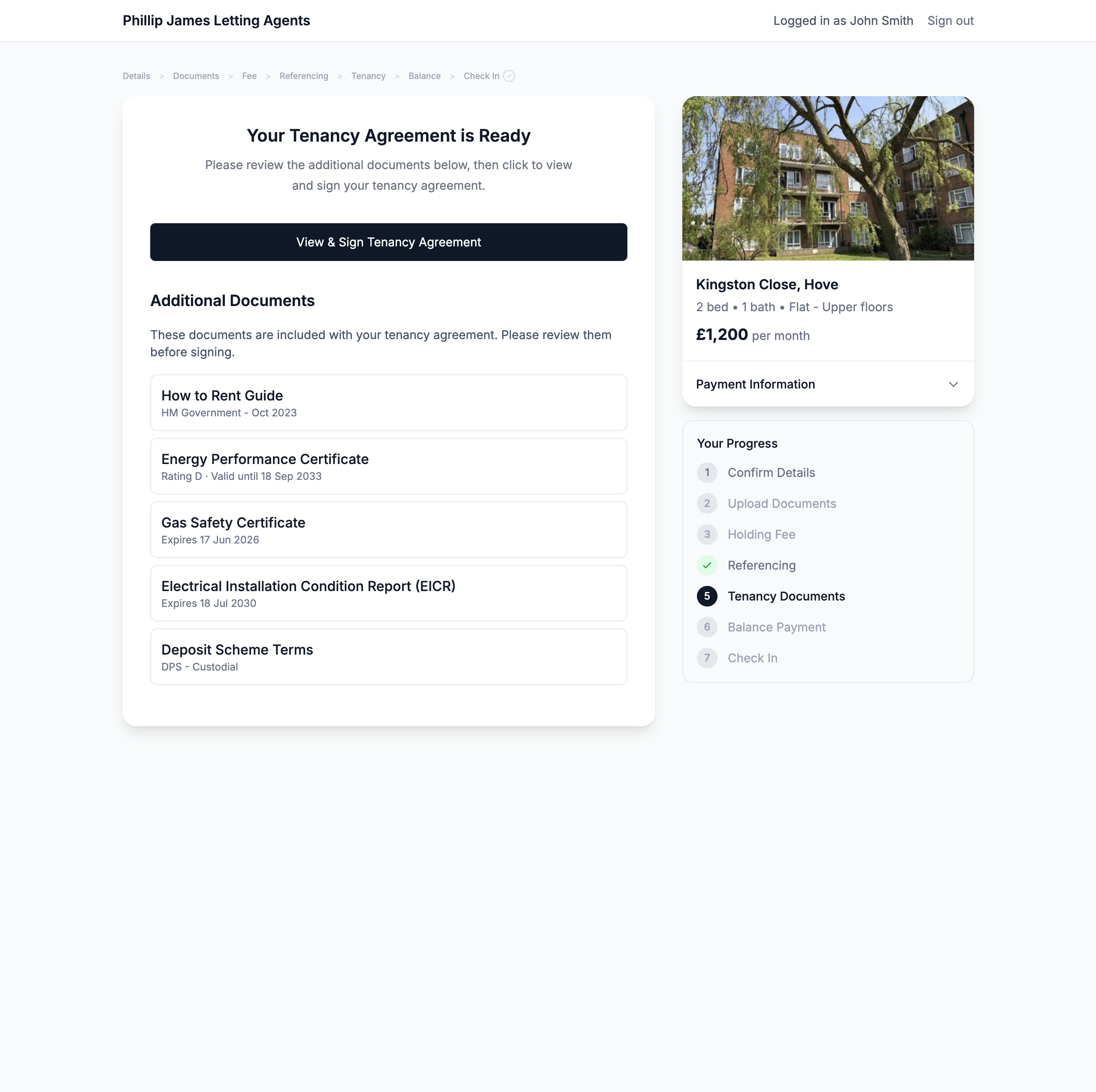
Tenancy records created only once legally complete. The tenancy doesn't appear in your active tenancy list until countersigning is complete. This prevents confusion about tenancy status and ensures nobody acts on an agreement that isn't fully executed.
Clean transition to the next stage. After countersigning, the system moves naturally to the next steps: balance payment collection, move-in preparation, deposit registration. There's no manual handoff or status changes required—the workflow progresses automatically.
All parties receive confirmation. Tenants receive email confirmation that the agreement is complete, with access to download their copy. The agent has confirmation. Everyone knows where they stand.
The Audit Trail (Quietly the Most Important Part)
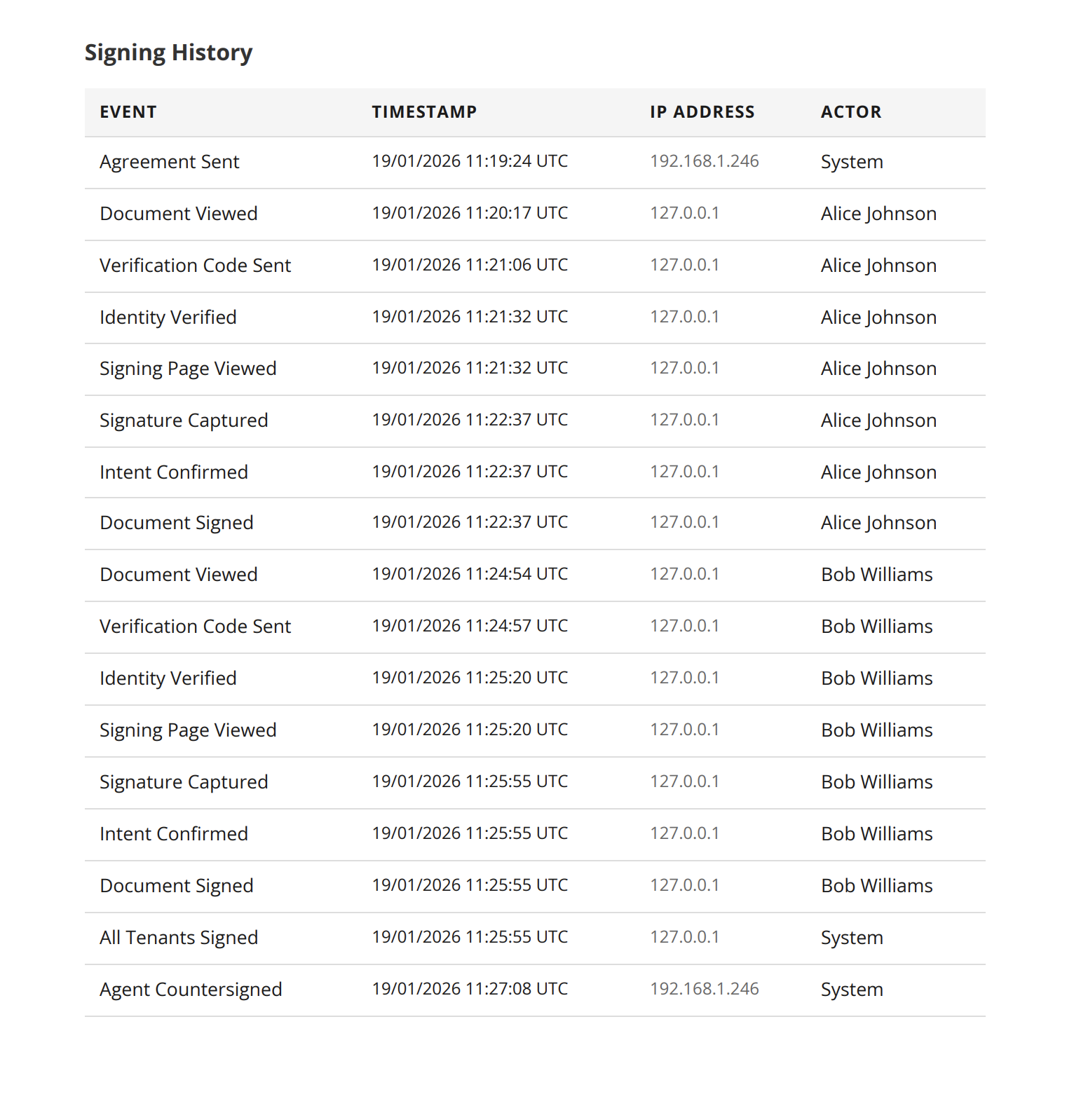
The audit trail is rarely looked at—until it's needed. Then it becomes the most important feature in the system.
What gets recorded:
- When the agreement was created
- When it was sent for signing
- When each verification code was requested and used
- When each tenant accessed the signing page
- When each signature was applied
- What IP address and browser were used
- When intent was confirmed
- When the agent countersigned
- When the final document bundle was generated
Every significant action is timestamped and logged. Not because tenants are assumed to be dishonest, but because disputes happen and evidence matters.
When it matters:
Consider a tenant who claims six months later that they never signed the agreement, or that they signed a different version, or that certain documents weren't provided. With a proper audit trail, you can demonstrate: they verified their identity at this time, accessed the agreement at this time, applied their signature at this time, and confirmed their intent at this time—all recorded with timestamps and session details.
This isn't theoretical. Deposit disputes, rent arrears cases, and possession proceedings all become easier when you have comprehensive evidence of process. The tenant's claim isn't just "your word against mine"—it's contradicted by a systematic record of what actually happened.
Why it protects both agent and landlord:
Agents need to demonstrate that they handled agreements correctly. Landlords need evidence that their tenancy was properly established. The audit trail serves both: it shows the agreement was sent with all required documents, signed by verified individuals with demonstrated intent, and countersigned in proper sequence.
Most of the time, you'll never need it. But when you do, you'll be very glad it's there.
What This Means Day-to-Day for Agents
Strip away the technical details and here's what changes for your team:
Fewer emails. No more sending agreements as attachments and waiting for replies. No more "did you get my email?" conversations. The system handles document delivery.
Less chasing. Automated reminders mean you're not tracking who's outstanding and manually following up. The software does the nagging.
Fewer mistakes. Compliance validation before sending catches missing documents before they become problems. You can't accidentally send an agreement without a valid Gas Safety certificate.
More confidence. When someone asks "can you prove this was handled correctly?", the answer is yes. Everything is recorded, timestamped, and available.
Calmer move-ins. Agreements are signed, compliance is documented, everything is in order before tenants arrive. Move-in day isn't a scramble to get paperwork finalised.
The goal isn't to add features to a checklist. It's to make the agreement process something you don't have to think about—because it works correctly by default.
Why We Built It This Way
LetAdmin isn't built from imagination. It's built from experience—years of watching tenancy agreements handled badly, disputes where nobody could prove what happened, and repetitive email chasing that consumed hours every week.
We didn't set out to build "a signing feature." We set out to answer the question: what would tenancy agreement handling look like if it was designed from scratch, knowing everything that can go wrong?
The answer is a system focused on correctness and evidence, not just convenience. Tenancy agreements have consequences—and the process should reflect that.
This Is How Tenancy Agreements Work in LetAdmin
Not because it's clever—but because it's calmer, safer, and easier to live with.
Tenancy agreements stop being a source of uncertainty. The compliance is validated. The signatures are verified. The evidence is recorded. The process is handled.
Your team can focus on the work that actually requires human judgment: tenant selection, landlord communication, property management. The agreement workflow runs in the background, correctly, without constant attention.
If you're managing multiple properties and tenancy agreement signing is currently a source of friction, we'd like to show you how this works in practice. No sales pitch—just a walkthrough of the workflow and a chance to ask questions.
Get in touch to arrange a conversation.
LetAdmin is in active development, built by letting agents for letting agents. The e-signing system described here is being used at Phillip James (370+ properties) and refined based on real-world usage. If you're interested in how it could work for your agency, we'd love to hear from you.