
The Renters' Rights Act comes into force on 1st May 2026. It's the biggest shake-up to private renting in a generation.
Section 21 "no fault" evictions are gone. Rent increases are restricted to once per year at market rate. Tenants get a 12-month "protected period" at the start of every tenancy. New grounds for possession. Tribunal reforms. Database registration requirements.
For letting agents, there are two ways to respond:
-
Treat it as a burden. More admin, more complexity, more things to track manually, more risk of getting it wrong.
-
Treat it as an opportunity. Automate the compliance. Use the new rules to have better conversations with landlords. Stand out from competitors who are drowning in spreadsheets.
We're building LetAdmin to make option 2 easy. Here's how.
The Big Changes (Quick Summary)
If you haven't read the full Act, here's what matters for day-to-day letting agency work:
Rent Increases: Once Per Year, Market Rate Only
- Old way: Rent review clauses, negotiated increases, various mechanisms
- New way: Section 13 notice only. Once per year maximum. Must be "market rate." Two months' minimum notice.
Tenants can challenge increases at the First-tier Tribunal if they believe it exceeds market rate. The tribunal will determine the correct market rent.
Protected Periods: No Eviction for 12 Months
- New rule: Landlords cannot evict tenants to move in themselves or sell the property during the first 12 months of a tenancy.
- After 12 months: These grounds become available, but require 4 months' notice.
This means every new tenancy has a built-in protected period that agents need to track.
Rent Arrears: Threshold Rises to 3 Months
- Old way: Mandatory possession at 2 months' arrears
- New way: Threshold increases to 3 months' arrears, with 4 weeks' notice (up from 2 weeks)
Database Registration Required
Landlords must register on the new Private Rented Sector Database. You cannot obtain possession if not registered (with limited exceptions).
Written Agreements Mandatory
All tenancies must have written agreements containing government-specified information. Verbal and informal arrangements need to be converted.
The Compliance Headache (Without Good Software)
Imagine managing 150 properties under the new rules, using spreadsheets:
For rent increases, you'd need to track:
- When did each tenancy start?
- When was the last rent increase?
- Has it been 12 months since the last increase?
- What's the current market rate for this property?
- When should we send the Section 13 notice (at least 2 months before)?
- Did the tenant challenge it? What evidence do we have?
For protected periods, you'd need to track:
- When did each tenancy start?
- Is it still within the 12-month protected period?
- When does the protected period end?
- Which grounds for possession are currently available?
For arrears, you'd need to track:
- Current arrears for each tenancy
- How many months behind?
- When does it hit the 3-month threshold?
- When can we serve notice?
Multiply this by 150 properties. Some tenancies started years ago, some last month. Different rent review dates, different circumstances, different landlord intentions.
This is spreadsheet hell. And getting it wrong has consequences—invalid notices, failed possession claims, landlord complaints, potential tribunal challenges.
How LetAdmin Handles This Automatically
We're building rent review and compliance features specifically for the Renters' Rights Act. Here's what the system does:
Automatic Rent Increase Suggestions
The system knows:
- When each tenancy started
- When rent was last increased
- The current rent amount
- Current market rates for comparable properties
What happens:
- LetAdmin automatically identifies tenancies eligible for rent review (12+ months since last increase)
- The system pulls market data from property portals to suggest an appropriate increase
- You see a list: "15 tenancies eligible for rent review this month"
- For each one, you see: current rent, suggested market rent, percentage increase, comparable evidence
One-click process:
- Review the suggestion
- Adjust if needed
- Click "Start Rent Review"
- System generates Section 13 notice with correct dates and amounts
- Notice sent to tenant (or queued for your review)
Time saved: What used to take 30-45 minutes per property (research, calculation, notice generation) now takes 2 minutes.
Market Rate Evidence (Tribunal-Ready)
Here's where it gets powerful.
When LetAdmin suggests a rent increase, it doesn't just give you a number. It provides evidence:
- Comparable properties currently on the market
- Recent lets in the same area
- Price per bedroom analysis
- Local market trends
This evidence is stored against the tenancy record.
If a tenant challenges the increase at tribunal, you have documentation ready:
- "Here are 6 comparable two-beds within 0.5 miles, all asking £1,400-£1,500"
- "Our proposed increase to £1,425 is within market range"
- "Evidence captured on [date] from [sources]"
You're not scrambling to find justification after a challenge. The evidence was collected when you made the decision.
Protected Period Tracking
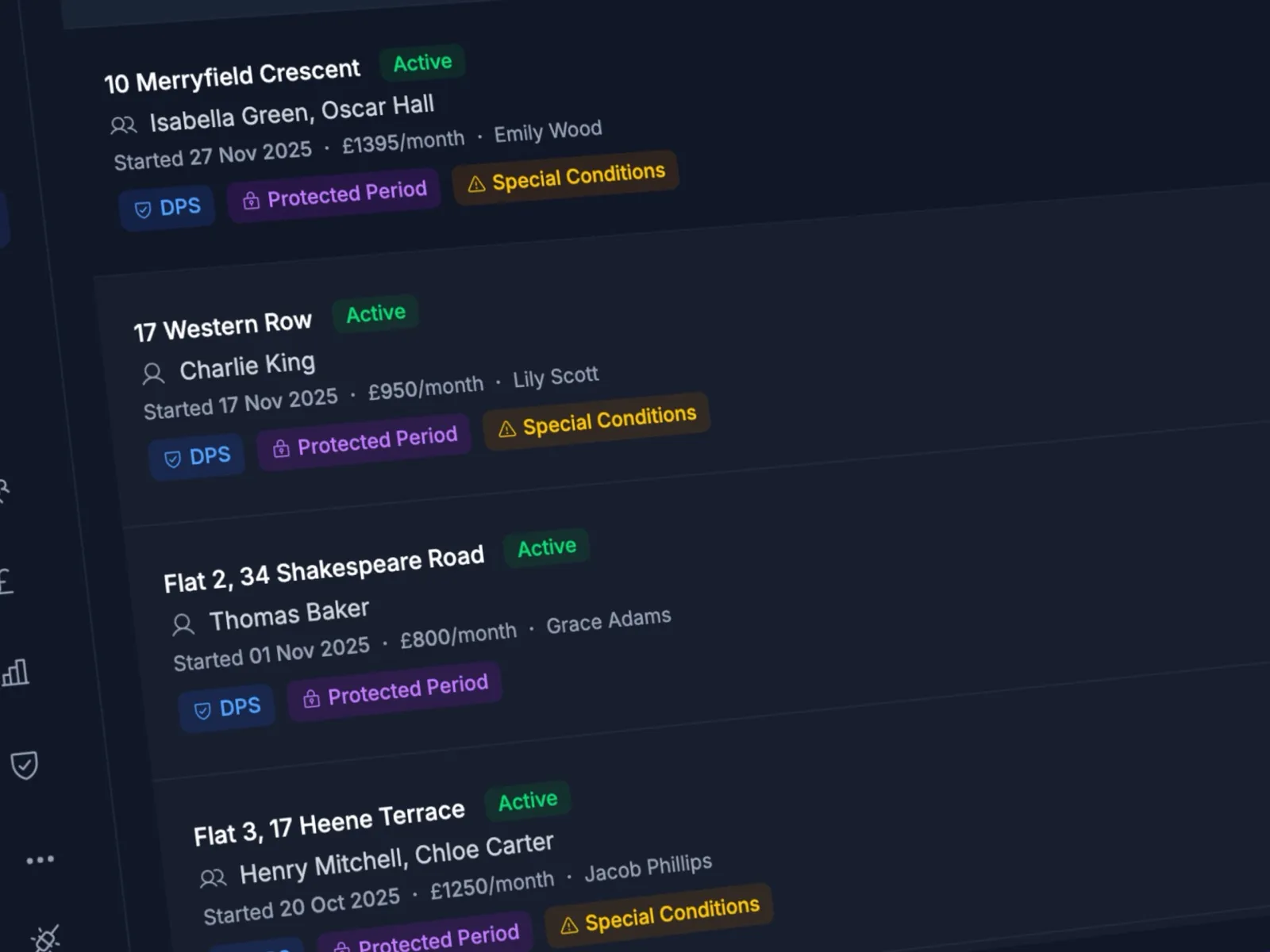
Every tenancy in LetAdmin shows its protected period status:
- "Protected until 15 March 2027" - Cannot use Ground 1 (landlord move-in) or Ground 1A (sale)
- "Protection ended" - All grounds available (subject to other requirements)
Visual indicators make this obvious:
- Tenancies in protected period show a shield icon
- Filter to see "all tenancies currently in protected period"
- Warnings if you try to start a process that isn't available yet
For landlords asking "can I sell?":
- Check the tenancy
- See "Protected until July 2026"
- Give an accurate answer immediately
No calendar calculations, no checking start dates, no mistakes.
Arrears Monitoring
LetAdmin tracks rent payments and calculates arrears automatically:
- Current status: "1 month, 2 weeks in arrears"
- Threshold tracking: "2 months, 1 week until Ground 8 threshold"
- Notice timing: "Ground 8 available from [date], notice must give 4 weeks"
Alerts at key stages:
- 1 month arrears: Early warning
- 2 months arrears: Escalation recommended
- 3 months arrears: Ground 8 available, notice can be served
No more manual calculations. The system knows the rules and applies them to your live data.
Turning Compliance Into Business Opportunity
Here's the mindset shift.
The old conversation with landlords:
"The new regulations are complicated. We'll do our best to keep up. Rent increases are trickier now."
The new conversation:
"The Renters' Rights Act actually creates opportunity. We use software that automatically identifies when your rent can be reviewed, pulls market data, and handles the process. You'll never miss a legitimate rent increase, and we have tribunal-ready evidence if tenants challenge."
Which agent would you choose?
The Numbers
Let's say you manage 150 properties with average rent £1,200/month.
Under the old system (manual tracking):
- Some rent reviews get missed (busy periods, staff changes, forgotten anniversaries)
- Let's say 20% of eligible increases don't happen
- That's 30 properties × £50 average increase = £1,500/month in missed landlord income
- £18,000/year in rent increases that didn't happen
Under LetAdmin (automatic identification):
- Every eligible tenancy flagged for review
- Market evidence provided automatically
- One-click process to initiate
- Zero missed opportunities
The software pays for itself many times over. And landlords notice when their agent consistently optimises their income.
Competitive Differentiation
When the Act comes into force, every agent will be dealing with the same complexity. The question is: how?
- Agents using spreadsheets: Drowning in manual tracking, making mistakes, missing opportunities
- Agents using basic software: Maybe some tracking, but manual market research, no evidence storage
- Agents using LetAdmin: Automatic suggestions, market evidence, one-click process, tribunal-ready documentation
Your pitch to landlords:
"We've invested in software specifically designed for the Renters' Rights Act. Your rent reviews happen automatically at the right time, with market evidence, fully compliant. Other agents are still figuring this out—we've already solved it."
What About Tenants?
Good question. The Renters' Rights Act is designed to protect tenants, and that's appropriate.
LetAdmin doesn't help you circumvent tenant protections. It helps you:
- Comply with the rules correctly (avoiding invalid notices)
- Justify increases with genuine market evidence (not arbitrary numbers)
- Give tenants proper notice periods (not last-minute surprises)
- Respect protected periods (not attempting evictions that will fail)
Fair rent increases, properly evidenced, correctly processed. That's what the Act intends, and that's what the software delivers.
Tenants benefit too: clear processes, proper documentation, no dodgy practices.
Implementation Timeline
The Act comes into force 1st May 2026.
That's approximately 5 months away. Here's what we recommend:
Now (November 2025):
- Understand the key changes
- Audit your current rent review processes
- Identify tenancies that will need attention post-May 2026
Q1 2026 (January-March):
- Ensure your software can handle the new requirements
- Set up market data tracking
- Train staff on new processes
April 2026:
- Final preparation before go-live
- Review protected period calculations for existing tenancies
- Prepare landlord communications
1st May 2026:
- Act comes into force
- New rules apply to ALL tenancies (existing and new)
- Fixed-term tenancies convert to periodic
LetAdmin will be ready. We're building these features now, tested with our own portfolio, refined based on real usage.
What We're Building
Specific features for Renters' Rights Act compliance:
Available now:
- Tenancy tracking with agreement history
- Rent increase recording and history
- Tenancy status management
Coming Q1 2026:
- Automatic rent review eligibility detection
- Market rate assessment with portal data
- Protected period calculation and display
- Section 13 notice generation
- Evidence storage for tribunal challenges
- Arrears threshold monitoring
- Ground availability indicators
The goal: When the Act comes into force, LetAdmin users don't need to think about compliance. The system handles it.
The Bottom Line
The Renters' Rights Act is coming. It adds complexity. There's no avoiding that.
But complexity creates opportunity for agents who handle it well. The agents who automate compliance will win landlords from agents who don't.
Two questions to ask yourself:
- How will you track rent review eligibility for every tenancy, every month?
- When a tenant challenges a rent increase, what evidence will you have?
If the answers involve spreadsheets and scrambling, there's a better way.
We'd Love to Talk
How are you preparing for the Renters' Rights Act? Manual processes? Existing software? Not sure yet?
What's your biggest concern about the new rules? Rent increase complexity? Protected periods? Tribunal challenges?
Would automated market assessments change how you approach rent reviews? We'd love to understand what would be most valuable.
Get in touch: paul@letadmin.com
LetAdmin is in active development, built by letting agents for letting agents. We're building Renters' Rights Act compliance features based on managing 370+ properties at Phillip James. If you want to turn the new regulations into competitive advantage rather than administrative burden, we'd love to hear from you.